


Hydraulic actuators are essential components used to convert hydraulic energy into mechanical motion, enabling the operation of heavy equipment and advanced industrial systems. These actuators are widely applied in sectors such as construction, manufacturing, aerospace, mining, oil & gas, and energy, where powerful motion control and high reliability are required. Their ability to generate strong force and operate efficiently under demanding conditions makes them indispensable in large-scale machinery and automated systems. As industries across the world continue to modernize operations and invest in advanced equipment, the demand for hydraulic actuators is steadily increasing.
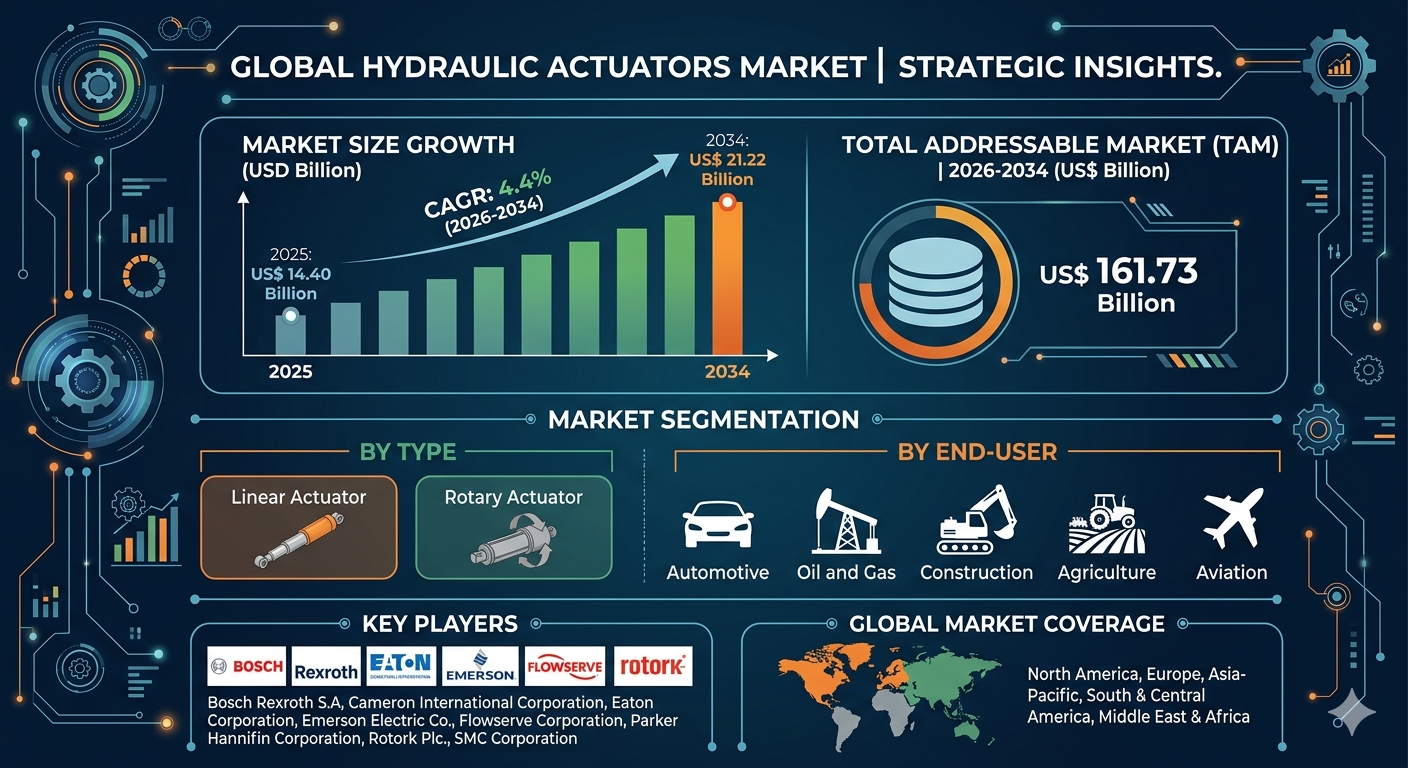
The Hydraulic Actuators Market Trends is experiencing steady global expansion driven by technological advancements and growing industrial activities. The hydraulic actuators market size is expected to reach US$ 21.22 Billion by 2034 from US$ 14.40 Billion in 2025, registering a CAGR of 4.4% during the forecast period 2026–2034. Increasing investments in industrial automation, infrastructure development, and energy projects are among the major factors contributing to this growth. Furthermore, industries are adopting advanced motion control technologies to enhance productivity and operational efficiency, which is accelerating the adoption of hydraulic actuator systems.
Download Sample PDF Copy of Report:
https://www.theinsightpartners.com/sample/TIPRE00007871
Industrial Automation Driving Actuator Adoption
Industrial automation has emerged as one of the most significant factors supporting the adoption of hydraulic actuators across manufacturing sectors. Companies are increasingly implementing automated production lines, robotics systems, and advanced machinery to improve efficiency and reduce operational costs.
Hydraulic actuators are widely used in automated manufacturing equipment such as hydraulic presses, injection molding machines, and material handling systems. These applications require precise motion control and powerful force output, making hydraulic actuation systems highly suitable. As Industry 4.0 technologies continue to expand and smart factory concepts gain traction, the integration of advanced hydraulic actuators in industrial machinery is expected to grow.
Infrastructure Development and Construction Equipment Demand
Infrastructure development projects across various regions are significantly contributing to the growth of hydraulic actuator technologies. Governments and private organizations are investing in transportation systems, urban infrastructure, industrial facilities, and energy projects. Construction equipment such as excavators, cranes, loaders, and bulldozers rely heavily on hydraulic actuators to perform lifting, digging, and material handling operations.
The increasing number of infrastructure modernization projects and urban expansion initiatives is driving the demand for advanced construction machinery. Hydraulic actuators provide the necessary force and reliability required for operating such heavy equipment, making them essential components in construction applications.
Growing Aerospace Industry Applications
The aerospace sector represents another important area of application for hydraulic actuators. Aircraft systems require reliable motion control technologies to operate critical components including landing gear, wing flaps, flight control surfaces, and cargo doors.
Hydraulic actuators are widely preferred in aerospace applications due to their ability to deliver high power density and dependable performance under extreme operating conditions. With the steady increase in global air travel and aircraft production, the aerospace industry continues to generate demand for advanced hydraulic actuation systems.
Expanding Oil & Gas and Energy Sector Use
Hydraulic actuators are extensively used in the oil & gas industry for valve control systems, drilling equipment, pipeline operations, and offshore platforms. These applications often involve high-pressure environments and challenging operating conditions where reliable motion control systems are required.
In addition to conventional energy sectors, hydraulic actuators are also gaining importance in renewable energy applications. Wind turbines utilize hydraulic actuators to manage blade pitch control systems and other mechanical functions necessary for efficient energy generation. As global energy demand continues to increase, investments in energy infrastructure are expected to support the growth of hydraulic actuator technologies.
Technological Advancements in Hydraulic Actuation Systems
Technological innovation is significantly enhancing the capabilities of hydraulic actuator systems. Manufacturers are increasingly developing electro-hydraulic actuators that combine hydraulic power with electronic control systems to deliver improved precision and automation capabilities.
Modern hydraulic actuators are also equipped with digital sensors and monitoring technologies that enable real-time performance tracking and predictive maintenance. These innovations help industries reduce equipment downtime and optimize operational efficiency. Furthermore, the development of compact and lightweight actuator designs is improving system efficiency while maintaining high performance.
Competitive Landscape and Key Companies
The hydraulic actuators industry features several global companies focusing on technological advancements and product development to strengthen their competitive position. Manufacturers are investing in research and development to improve actuator performance, reliability, and efficiency across various industrial applications.
Key companies operating in the hydraulic actuators market include:
- Parker Hannifin Corporation
- Bosch Rexroth AG
- Emerson Electric Co.
- Moog Inc.
- Honeywell International Inc.
- Eaton Corporation
- Rotork PLC
- Flowserve Corporation
- Pentair PLC
- Wipro Infrastructure Engineering
These companies continue to expand their global presence through innovation, strategic partnerships, and the development of advanced hydraulic solutions.
Future Outlook
The future outlook for hydraulic actuators remains positive as industries worldwide continue to invest in automation, infrastructure development, and advanced machinery. The growing demand for high-performance equipment across sectors such as construction, aerospace, manufacturing, and energy is expected to support sustained industry expansion through 2034.
Additionally, ongoing innovations in electro-hydraulic technologies, smart monitoring systems, and energy-efficient actuator designs will further enhance the performance and reliability of these systems. As industries prioritize operational efficiency, productivity, and safety, hydraulic actuators will continue to play a crucial role in supporting modern industrial operations globally.
About Us
The Insight Partners is a leading market research and consulting firm that provides actionable insights into emerging technologies, industry trends, and competitive landscapes. The company delivers syndicated and customized research reports across industries including electronics, automotive, aerospace, manufacturing, healthcare, and information technology. With experienced analysts and comprehensive research methodologies, The Insight Partners helps organizations identify growth opportunities and develop effective strategic decisions.
Contact Us
If you have any queries regarding this report or require customization, please contact our research team.
The Insight Partners
Email: sales@theinsightpartners.com
Website: https://www.theinsightpartners.com
Related Reports -
Personal Cooling Device Market Regional Share, Trend, and Growth Opportunity
Semiconductor Defect Inspection System Market Regional Share, Trend, and Growth Opportunity

 English
 Arabic
 French
 Spanish
 Portuguese
 Deutsch
 Turkish
 Dutch
Dutch
 Italiano
 Russian
 Portuguese (Brazil)
 Tiếng Việt