


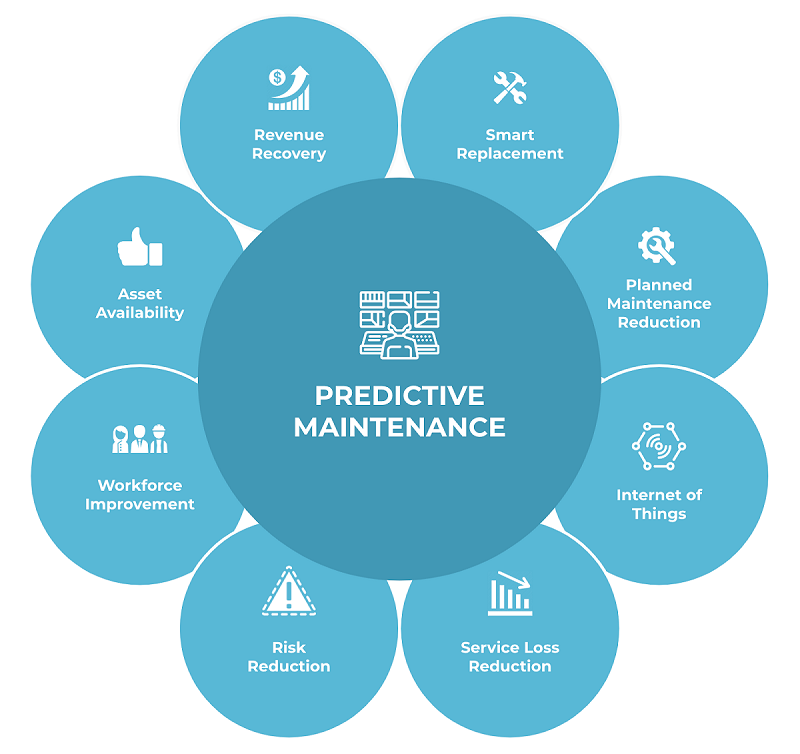
The global industrial sector's aggressive push towards digitalization and operational efficiency is clearly reflected in the substantial and rapidly growing Predictive Maintenance Market Size. This market, which encompasses the total global spending on the hardware, software, and services required to implement predictive maintenance (PdM) solutions, is already a multi-billion-dollar industry. More impressively, it is projected to grow at a strong double-digit compound annual growth rate (CAGR) over the next decade, making it one of the cornerstone markets of the broader Industry 4.0 movement. This impressive valuation is driven by a clear and compelling value proposition: the ability to significantly reduce costly unplanned downtime, optimize maintenance spending, and extend the life of critical industrial assets. As more companies move beyond pilot projects to full-scale deployments, the investment in PdM technologies is shifting from a discretionary R&D expense to a core operational budget item, ensuring the market's continued and robust expansion on a global scale.
To fully appreciate the market's size, it is essential to break it down into its three main components. The software segment represents a major portion of the market revenue. This includes the licensing and subscription fees for a wide range of software, from the cloud-based IoT platforms that ingest and manage sensor data to the specialized machine learning and analytics platforms used to build the predictive models. The services segment is also a massive contributor to the market size, and is often the largest component. This encompasses the spending on consulting to develop a PdM strategy, the fees for system integrators to implement and connect the various hardware and software components, and the ongoing managed services for monitoring and maintaining the system. As many industrial companies lack deep in-house data science expertise, they rely heavily on these external service providers. The hardware segment, which includes the cost of IoT sensors, edge gateways, and networking equipment, is also a significant and fast-growing part of the market, as the instrumentation of physical assets is the necessary first step for any PdM initiative.
The geographic distribution of the predictive maintenance market size highlights where the adoption of Industry 4.0 is most advanced. North America, particularly the United States, currently holds the largest market share. This is due to the presence of a large and technologically advanced industrial base, significant investment in digital transformation, and a strong ecosystem of technology vendors. Europe is a very close second, with Germany's "Industrie 4.0" initiative making it a powerhouse in the adoption of PdM in the manufacturing sector. The region's strong focus on high-value manufacturing and process industries provides a fertile ground for these technologies. The Asia-Pacific (APAC) region is projected to be the fastest-growing market for predictive maintenance. The massive scale of manufacturing in China, coupled with a government-led push for smart manufacturing, is driving huge investments. Other countries like Japan, South Korea, and India are also rapidly adopting PdM to improve the competitiveness of their industrial sectors, making APAC a key engine of future global market growth.
Looking forward, several powerful trends will ensure the continued and accelerated growth of the market's already impressive size. The cost of the enabling technologies—sensors, cloud computing, and data storage—continues to fall, making PdM solutions more accessible to a wider range of companies, including small and medium-sized enterprises (SMEs). The continuous advancements in artificial intelligence and machine learning are making the predictive models more accurate and easier to build, further increasing their value and appeal. Furthermore, the expansion of PdM into new industries and asset classes, from healthcare equipment to commercial building systems, is constantly enlarging the total addressable market. As the world's industrial infrastructure continues to age and the pressure to operate more efficiently and sustainably intensifies, the business case for predictive maintenance will only become stronger, guaranteeing that its market size will continue on a strong upward trajectory for the foreseeable future.
Explore More Like This in Our Trending Reports:
Transportation Analytics Market

 English
 Arabic
 French
 Spanish
 Portuguese
 Deutsch
 Dutch
Dutch
 Italiano
 Russian
 Romaian
 Portuguese (Brazil)
 Tiếng Việt