
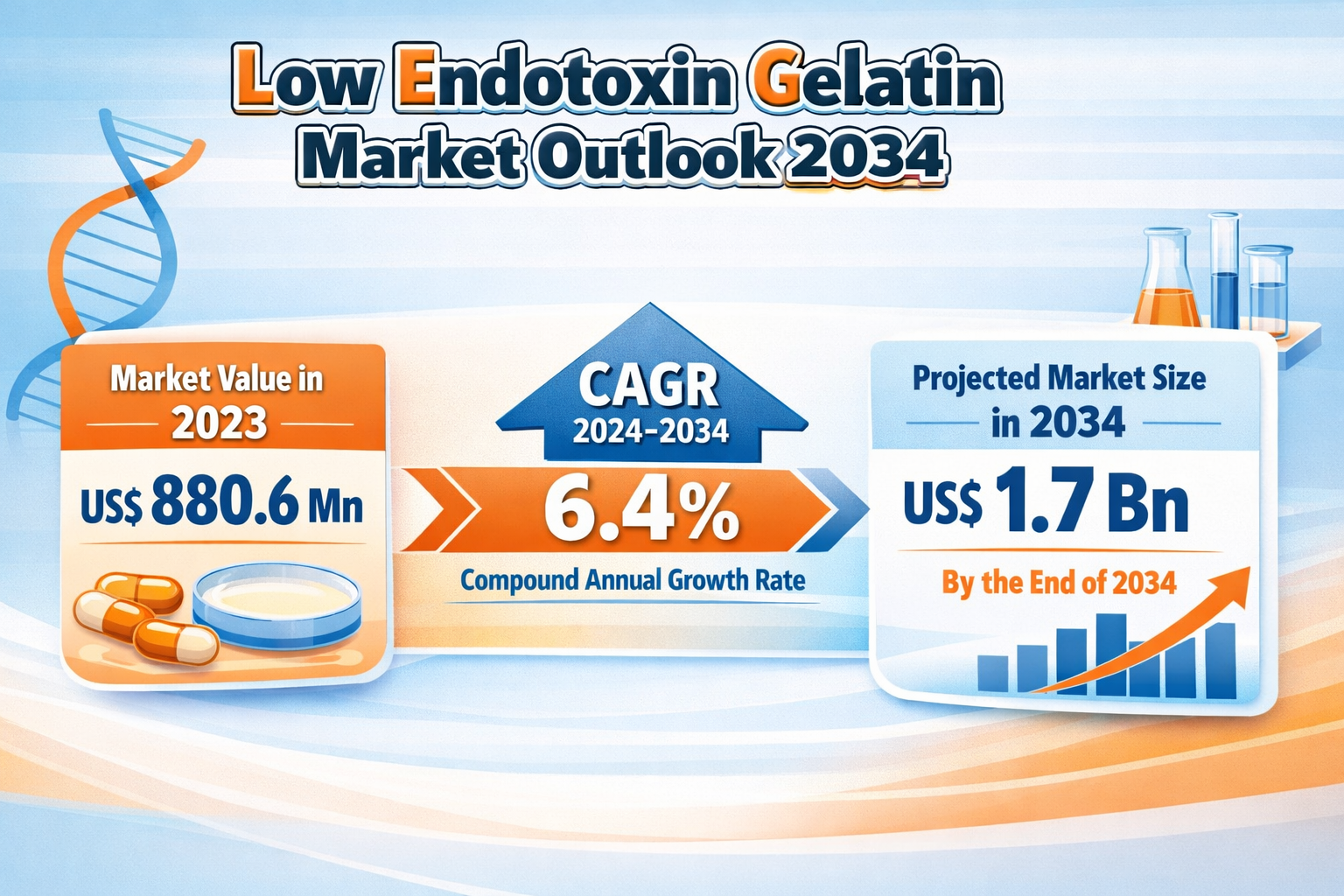
The Low Endotoxin Gelatin Market is rapidly evolving as a critical material for pharmaceutical, biotechnology, and regenerative medicine applications. Valued at US$ 880.6 million in 2023, the market is projected to grow to US$ 1.7 billion by 2034, exhibiting a CAGR of 6.4% during the forecast period of 2024–2034. This growth is driven by technological advancements in 3D bioprinting, increased demand for faster wound healing, and the expanding application of low endotoxin gelatin in pharmaceutical and biomedical research.
Overview of Low Endotoxin Gelatin
Gelatin is a protein derived from collagen, commonly used across pharmaceuticals, food & beverages, and biotechnology sectors. Low endotoxin gelatin is specially processed to minimize pyrogen content, providing enhanced biocompatibility and reduced immune response risk. Endotoxins—lipopolysaccharides from gram-negative bacteria—can trigger severe immune reactions, including fever, hypotension, and shock.
The low endotoxin gelatin market has gained prominence due to its safety in in-body biomedical applications. Derived primarily from alkaline-treated porcine skin, it complies with global safety standards, including U.S. FDA GRAS status, European Pharmacopeia, and Japanese Pharmacopeia guidelines. Its utilization is especially important in tissue engineering, drug delivery systems, and regenerative medicine.
Market Dynamics
Drivers
Rising Adoption of 3D Bioprinting
One of the most significant growth drivers is the increasing application of 3D bioprinting technology. Low endotoxin gelatin serves as a bioink, valued for its biodegradability, biocompatibility, and cell-binding properties.
By adjusting crosslinking reactions and polymerization conditions, manufacturers can produce hydrogels with specific morphologies and mechanical properties. These hydrogels enable precise bioprinting of endothelial, cardiac, skin, tumor, osteogenic, chondrogenic, hepatic, adipogenic, vasculogenic, and epithelial tissues. By reducing tissue rejection risk, low endotoxin gelatin ensures reliable outcomes in regenerative medicine and tissue engineering applications.
Accelerated Wound Healing
With chronic wounds and trauma becoming more prevalent, the demand for faster wound healing solutions has grown. Low endotoxin gelatin exhibits hemostatic, adhesive, and antibacterial properties, supporting rapid wound closure.
Its non-antigenic nature reduces immune complications, making it suitable for advanced wound care applications. As per the National Institutes of Health, the advanced wound care industry is expected to reach US$ 18.7 billion by 2027, signaling a robust opportunity for low endotoxin gelatin in medical and clinical settings.
Pharmaceutical and Biotechnology Applications
Low endotoxin gelatin is increasingly used in drug delivery systems, vaccines, embolization agents, and hemostatic products. Its controlled endotoxin levels, biodegradability, and batch-to-batch consistency make it ideal for high-value pharmaceutical and biomedical products.
In biotechnology, low endotoxin gelatin serves as a key material for 3D bioprinting, tissue scaffolds, and organ-on-chip platforms. Its biocompatibility ensures safe integration with living cells, expanding its applications in regenerative medicine research.
Restraints
Despite its advantages, the market faces challenges, including:
-
High Production Costs: Purification and quality control processes for low endotoxin gelatin increase production expenses.
-
Regulatory Compliance: Strict regulations for biomedical and pharmaceutical applications can slow market entry for new players.
-
Raw Material Dependence: Reliance on porcine skin as the primary raw material can create supply volatility.
Opportunities
-
Emerging Markets Expansion: Asia Pacific, Latin America, and MEA offer untapped growth potential.
-
Integration with Bioactive Molecules: Combining gelatin with growth factors and stem cells enhances tissue engineering applications.
-
Strategic Collaborations: Partnerships with research institutions, hospitals, and biotechnology companies can increase market penetration.
Market Segmentation
By Type
-
Type A (Acid Process Gelatin) – Acid-hydrolyzed gelatin suitable for pharmaceutical and food applications.
-
Type B (Alkaline Process Gelatin) – Alkaline-hydrolyzed gelatin with higher molecular weight, ideal for bioprinting and tissue engineering.
By Application
-
Pharmaceuticals – Hemostatic agents, embolization, vaccines, and drug delivery.
-
Biotechnology Companies – Bioinks, scaffolds, tissue engineering applications.
-
Food & Beverage Industry – Low endotoxin stabilizers and gelling agents.
-
Others – Cosmetic, nutraceutical, and specialized biomedical applications.
Regional Analysis
North America
North America leads the market due to high adoption of stem cell therapies, CAR-T cell development, and tissue regeneration research. The U.S. is a hub for advanced wound care solutions, regenerative medicine research, and biotechnology innovation. Canada also contributes with investments in regenerative therapies and tissue engineering research.
Europe
Europe demonstrates steady growth, supported by strong regulatory frameworks and biotechnology research infrastructure. Key countries include Germany, France, and the U.K., focusing on advanced wound care and regenerative medicine.
Asia Pacific
The Asia Pacific market is expected to grow rapidly due to healthcare investments, pharmaceutical expansion, and increasing 3D bioprinting adoption. China, India, Japan, and Australia are key markets, benefiting from government support for biomedical research and medical technology development.
Latin America & MEA
These regions present gradual growth opportunities. Awareness of advanced wound care, regenerative medicine, and biotechnology research is increasing, particularly in Brazil, Mexico, GCC countries, and South Africa.
Competitive Landscape
The low endotoxin gelatin market is highly competitive, with major players focusing on product innovation, strategic partnerships, and regulatory compliance. Notable companies include:
-
Rousselot
-
Gelita AG
-
Nitta Gelatin NA Inc.
-
Tessenderlo Group
-
Weishardt
-
Trobas Gelatine BV
-
Ewald-Gelatine GmbH
-
Norland Products Inc
-
Lapi Gelatine Spa
-
Junca Gelatines S.L.
Key Developments
In October 2022, Darling Ingredients introduced Quali-Pure, a low endotoxin gelatin product designed for wound healing, drug delivery, embolization, and hemostasis. The product ensures controlled endotoxin levels, biocompatibility, biodegradability, and compliance with EU MDR and ISO 22442 standards.
Such innovations reflect the market’s emphasis on high-quality gelatin products suitable for advanced pharmaceutical and biomedical applications.
Market Trends
-
Bioink Adoption – Low endotoxin gelatin is increasingly used in 3D bioprinting and tissue engineering.
-
Personalized Medicine – Customized scaffolds are enhancing patient-specific therapies.
-
Sustainability Focus – Emphasis on eco-friendly sourcing and production methods.
-
Integration with Stem Cells and Growth Factors – Enhancing regenerative medicine outcomes.
Future Outlook
The low endotoxin gelatin market is expected to maintain steady growth through 2034, driven by the increasing adoption in regenerative medicine, 3D bioprinting, and advanced wound care. North America will remain the largest market, with Europe and Asia Pacific witnessing substantial growth. Emerging markets in Latin America and MEA are expected to contribute to global demand gradually.
Technological innovations, increasing collaborations, and growing awareness of the material’s biocompatibility, safety, and versatility will ensure continued adoption in pharmaceutical, biotechnology, and biomedical applications.
Conclusion
The Low Endotoxin Gelatin Market is set to experience robust growth over the next decade, driven by rising demand for biomedical, pharmaceutical, and regenerative medicine applications. Its unique properties, regulatory compliance, and suitability for advanced bioprinting applications make it an essential component for next-generation healthcare solutions.

 English
 Arabic
 French
 Spanish
 Portuguese
 Deutsch
 Turkish
 Dutch
Dutch
 Italiano
 Russian
 Romaian
 Portuguese (Brazil)