


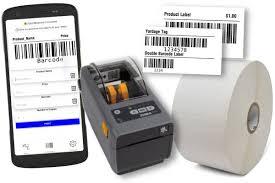
The convergence of traditional barcoding and Radio Frequency Identification (RFID) is a defining trend in the barcode label printer market today. While standard barcodes require line-of-sight scanning, RFID-enabled labels allow for the simultaneous reading of multiple items from a distance, even through packaging. Modern barcode printers are increasingly being equipped with RFID encoding modules, allowing them to print a visual barcode while simultaneously programming the embedded chip. This dual-capability is vital for industries like high-end retail and pharmaceuticals, where both human-readable information and high-speed automated tracking are required. The ability to verify the contents of an entire pallet in seconds without opening a single box has revolutionized receiving and shipping workflows. As the cost of RFID tags continues to fall, the adoption of these hybrid printers is accelerating, moving beyond niche applications into mainstream supply chain management, where they provide an unprecedented level of visibility and security.
In this discussion, we should address the technical challenges and rewards of implementing RFID-enabled printing systems. These printers require sophisticated software to manage the data being encoded and to ensure that the digital information on the chip matches the printed information on the label. The "smart" labels produced by these machines are essential for anti-counterfeiting measures, as they can store encrypted data that is nearly impossible to replicate. Moreover, the data captured by these labels feeds into sophisticated analytics platforms, providing businesses with deep insights into their inventory dwell times and logistics bottlenecks. The transition to RFID is not about replacing barcodes but about enhancing them with a layer of digital intelligence. As we look at the Barcode Label Printer Market trends, it is clear that the demand for multi-functional devices that handle both visual and electronic identification is a primary driver of industry investment and innovation.
FAQs: What is the advantage of a printer that handles both barcodes and RFID? It provides redundancy and flexibility, allowing for high-speed automated tracking via RFID while maintaining a human-readable barcode for manual backup or traditional scanning.
Is RFID technology becoming more affordable for smaller businesses? Yes, the cost of both RFID tags and the printers capable of encoding them has decreased significantly, making the technology accessible to a wider range of SMEs.
➤➤➤Explore MRFR’s Related Ongoing Coverage In Semiconductor Industry:
Financial Modeling And Valuation Services Market
Financial Planning Services Market
Financial Reporting Consulting Services Market
Financial Software And Technology Consulting Services Market
Fleet Management Services Market
Forensic Accounting And Fraud Investigation Services Market
Freight And Shipping Solutions Consulting Services Market
Geotargeting And Location Based Marketing Services Market
Global Workforce And Talent Acquisition Services Market
Green Building Materials And Consulting Services Market

 English
 Arabic
 French
 Spanish
 Portuguese
 Deutsch
 Turkish
 Dutch
Dutch
 Italiano
 Russian
 Romaian
 Portuguese (Brazil)