


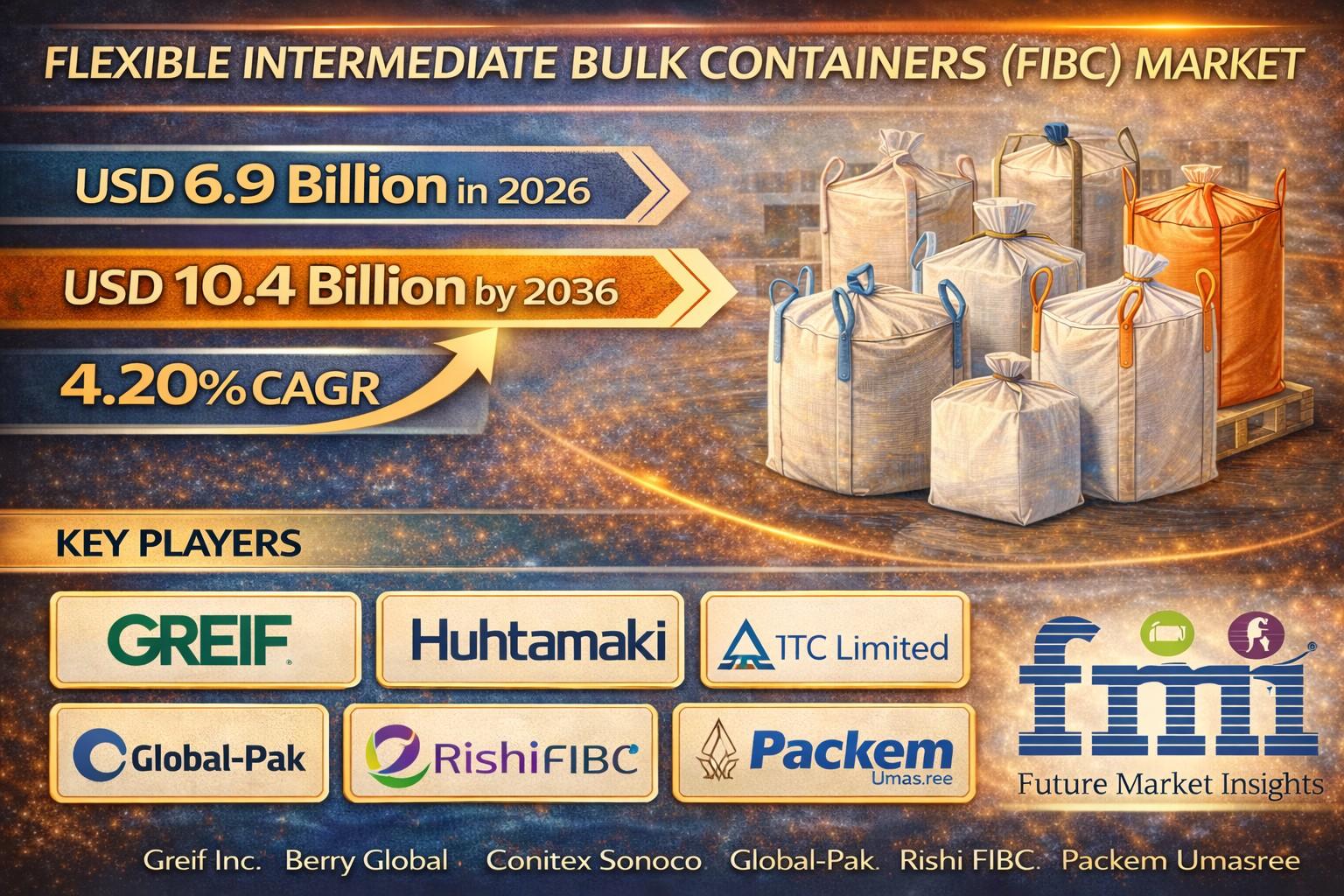
The global flexible bulk container (FIBC) market is valued at $6.6 billion in 2025, rising to $6.9 billion in 2026, and projected to reach $10.4 billion by 2036, with a compound annual growth rate (CAGR) of 4.20%. This market expansion reflects the increasing global trade in hazardous chemicals, agricultural products, and bulk food goods, where the use of standard packaging ensures safety, cost-effectiveness, and regulatory compliance. A key structural driver is the shift toward refurbished and recycled packaging, altering the economics of procurement for exporters. As of September 2025, Greif reported having refurbished or recycled over 4.5 million containers, demonstrating a growing buyer preference for lifecycle packaging services. Safety regulations are also reshaping procurement decisions. According to the Maritime Institute, improper handling of chemicals in bulk bags can cause serious fires on ships, reinforcing the need for certified Class C and Class D antistatic bags.
- Market Size (2026): $6.9 billion
• Market Size (2036): $10.4 billion
• Compound Annual Growth Rate (CAGR) (2026–2036): 4.20%
• Leading Product Category: Category A (44% market share)
• Fastest Growing Product Category: Category D
• Leading Material: Polypropylene (78% market share)
• Leading End-Use Industry: Chemicals (30% market share)
• Fastest Growing Country: India (CAGR 5.8%)
• Key Growth Drivers: Circular Economy and Hazardous Goods Regulation Compliance
• Key Opportunity: Product Lifecycle Refurbishment Services
Definition
The flexible intermediate bulk packaging (FIBC) market encompasses the global production and trade of large woven industrial sacks used for transporting dry, fluid materials.
Also known as: Jumbo bags, large sacks, extra-large bags
Maximum load capacity: 500 kg – 2,000 kg
Include
- Electrostatic variants A, B, C, D
- Disposable and reusable FIBC bags
- Composite textile materials and polypropylene
- Industrial applications in the chemical, agricultural, pharmaceutical, and construction sectors.
Excluded
- Rigid intermediate bulk container
- Consumer packaging
- Woven bags not for industrial use
Key market drivers
- ♻️ Circular economy regulations: Mandatory regulations on recycled polypropylene (rPP) in Europe and North America encourage manufacturers to adopt recycled fabrics and closed-loop systems.
- ⚠️ Safety standards for hazardous goods: Anti-static bags that meet standards help prevent the risk of ignition during the transportation of flammable goods.
- 💰 Cost advantages over rigid containers: FIBC bags have lower return shipping costs due to their foldable design and lightweight construction.
- 🌏 Expanding industrial activity in the Asia Pacific region: Growth in chemical and petrochemical production capacity is increasing the demand for heavy-duty bulk packaging.
Download the report template at: https://www.futuremarketinsights.com/reports/sample/rep-gb-14500
Segment analysis
By product type
Type A FIBC bags dominate the market with a 44% share due to their widespread use in the transport of non-hazardous bulk goods.
However, safety regulations are shifting purchasing trends toward more advanced versions:
- Type B – Prevents the spread of electrical discharge from carbon brushes
• Type C – Requires grounding; for use in flammable environments
• Type D – Dissipates static electricity without grounding; fastest rate of development
According to material
Polypropylene (PP) leads the market with a 78% share by volume due to its strength-to-weight ratio and compatibility with textiles.
Emerging physical changes include:
- Polyethylene liners for moisture-sensitive goods
• Multilayer metal films for oxygen/light-sensitive chemicals
• Recycled blends (rPP/rPET) for sustainability compliance
According to the final intended use
The chemical industry leads with a 30% market share , thanks to its polymer products, fertilizers, and specialty additives.
Other areas of growth include:
- Food & Pharmaceuticals – Cleanroom-compliant sanitary bags
• Agriculture – Improved efficiency in transporting grains and seeds
• Construction – Transport of construction materials and waste
Detailed information by region
🇮🇳 India — Fastest-growing market (compound annual growth rate of 5.8%): Growth is supported by the expansion of manufacturing under the “Make in India” program and initiatives to enhance export competitiveness.
🇨🇳 China — Driving demand for petrochemicals (Compound Annual Growth Rate of 5.2%): Demand for packaging is increasing along with the expansion of refining and polymer production.
🇨🇦 Canada — Promoting Circularity through Regulations (Compound Annual Growth Rate of 4.8%): Federal plastic registration regulations encourage the purchase of products with high recycling content.
🇹🇷 Turkey — EU Coastal Supplier (Compound Annual Growth Rate 4.5%): Export-oriented plastic packaging production supports steady growth.
🇺🇸 United States — Regulatory-Oriented Market (Compound Annual Growth Rate of 3.8%): Demand is focused on hazardous materials logistics, governed by regulations on pipeline safety and hazardous materials .
🇩🇪 Germany — A leader in the circular economy (compound annual growth rate of 3.5%): Focusing on integrating sustainable rPP and highly reliable industrial packaging.
Competitive landscape
The market is splitting into two groups: bulk suppliers and value-driven leaders .
Key figures
- Pain
- Global Berries
- Conitex Sonoco
- LC Packaging
- Ameriglobe
Competitive advantage
- Vertical integration for recycled materials
• UN hazardous goods certification • Lifecycle collection and refurbishment services • Digital tracking and reverse logistics • Export-standard compliant infrastructure
Market opportunities
🔹 Integrated rPET recycling from bottles to bags
🔹 Smart FIBC bags with RFID integration for product lifecycle tracking
🔹 Premium hazardous waste transport solutions
🔹 Anti-static bulk packaging meeting pharmaceutical standards
🔹 Weight-reduction design to lower plastic taxes
Frequently Asked Questions
How big is the FIBC packaging market?
It reached $6.9 billion in 2026 and is projected to reach $10.4 billion by 2036.
What is driving this growth?
Circular economy regulations and safety standards for hazardous goods.
Which product type is dominant?
Large sacks, type A.
Which material is most commonly used?
Polypropylene fabric.
Which region is growing the fastest?
The Asia-Pacific region, led by India and China.
What is the main challenge?
The cost of strict compliance and safety certification.
Why choose FMI: https://www.futuremarketinsights.com/why-fmi
Contact us:
Future Market Insights Inc.
Christiana Corporate, 200 Continental Drive, Suite 401, Newark, Delaware - 19713, USA. Phone: +1-347-918-3531. Sales contact: sales@futuremarketinsights.com. Website: https://www.futuremarketinsights.com.
About Future Market Insights (FMI):
Future Market Insights, Inc. (FMI) is an ESOMAR-certified market research and consulting firm, ISO 9001:2015 certified, trusted by Fortune 500 clients and global businesses. Operating in the United States, the United Kingdom, India, and Dubai, FMI provides data-driven insights and strategic information across more than 30 industries and 1200 markets worldwide.

 English
 Arabic
 French
 Spanish
 Portuguese
 Deutsch
 Turkish
 Dutch
Dutch
 Italiano
 Russian
 Romaian
 Portuguese (Brazil)