


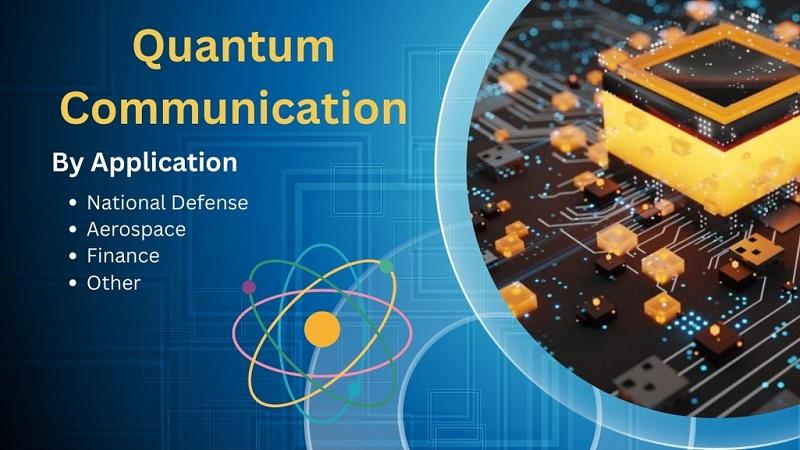
The Quantum Communication Market Outlook points to a future where physically secure communication becomes a standard and essential layer of our global digital infrastructure, particularly for government, finance, and critical industries. The industry is on a clear trajectory to move from niche, point-to-point deployments to a more widespread and interconnected global network. The long-term vision is one of a "quantum internet" that not only provides unhackable security but also enables entirely new quantum technologies. This compelling future is confidently supported by strong financial forecasts, with the Quantum Communication Market is Expected to Reach a Valuation of USD 17.94 Billion by 2035, Reaching at a CAGR of 29.32% during 2025 - 2035.
In the near-to-medium-term outlook, the key theme will be the expansion of Quantum Key Distribution (QKD) networks and the development of satellite-based systems. We will see the deployment of more metropolitan-area QKD networks connecting government buildings, financial institutions, and data centers. The focus will be on improving the performance (key rate and distance) of these systems and on integrating them more seamlessly with existing network equipment. The most exciting development in this period will be the launch of several new QKD satellite missions by different countries and companies, which will demonstrate the feasibility of intercontinental quantum communication and lay the groundwork for a global network.
Looking further ahead, the long-term outlook is centered on the ambitious goal of building a true quantum internet. This is a much more complex challenge than QKD. A quantum internet would need to be able to transmit and store fragile quantum states (qubits) without destroying them. This requires the development of two key technologies that are currently in the early stages of research: "quantum repeaters," which can extend the range of quantum entanglement over long distances, and "quantum memory," which can store a quantum state for a period of time. The successful development of these technologies would enable the connection of quantum computers around the world, opening the door to powerful applications like distributed quantum sensing and blind quantum computing.
However, for this future to be realized, the industry must continue to overcome significant technical and economic hurdles. The cost of quantum communication hardware needs to be dramatically reduced for it to be adopted beyond high-security niche applications. The development of industry-wide standards for interoperability between equipment from different vendors is also crucial for building a large-scale network. The industry will also exist in a hybrid world, competing and collaborating with another approach to quantum-safe security: post-quantum cryptography (PQC), which involves developing new classical algorithms that are resistant to quantum attack. The future of secure communication will likely involve a combination of both of these approaches, with quantum communication providing the ultimate layer of physical security for the most critical data links.
However, for this future to be realized, the industry must continue to navigate the challenge of declining print volumes and prove its value in the digital realm. The most successful providers will be those who can effectively pivot their business model and their sales compensation plans from being based on the volume of printed pages to being based on the value of the digital services they provide. They must also continue to invest heavily in their cybersecurity capabilities, as managing a wider range of connected devices also means managing a wider attack surface. Despite these challenges, the outlook is positive for the providers who can successfully make this strategic evolution. The fundamental need for secure, efficient, and well-managed document and information workflows, whether physical or digital, ensures that the industry will have an important role to play for many years to come.
Explore Our Latest Trending Reports:
Commercial Security Robot Market Size

 English
 Arabic
 French
 Spanish
 Portuguese
 Deutsch
 Turkish
 Dutch
Dutch
 Italiano
 Russian
 Romaian
 Portuguese (Brazil)